GPSR: What E-Commerce Retailers Need to Know Now
25. June 2026
The GPSR applies to product pages, labels, and e-commerce processes. Find out what obligations online retailers need to be aware of now…
Overview
- You'll learn what the GPSR means for online stores, retailers, and brands, and what information is important to include on product pages, labels, and packaging.
- You'll see how clear product labeling, traceability, and internal processes strengthen your product safety and reduce legal risks.
- You can use the EU Product Safety Regulation as an opportunity to build trust, create better product pages, and improve your visibility.
The GPSR changes how products are sold, labeled and monitored in the EU. Since December 13, 2024, the new EU General Product Safety Regulation has applied directly in the European Union. It replaces the previous General Product Safety Directive and sets higher requirements for manufacturers, importers, retailers and online marketplaces.
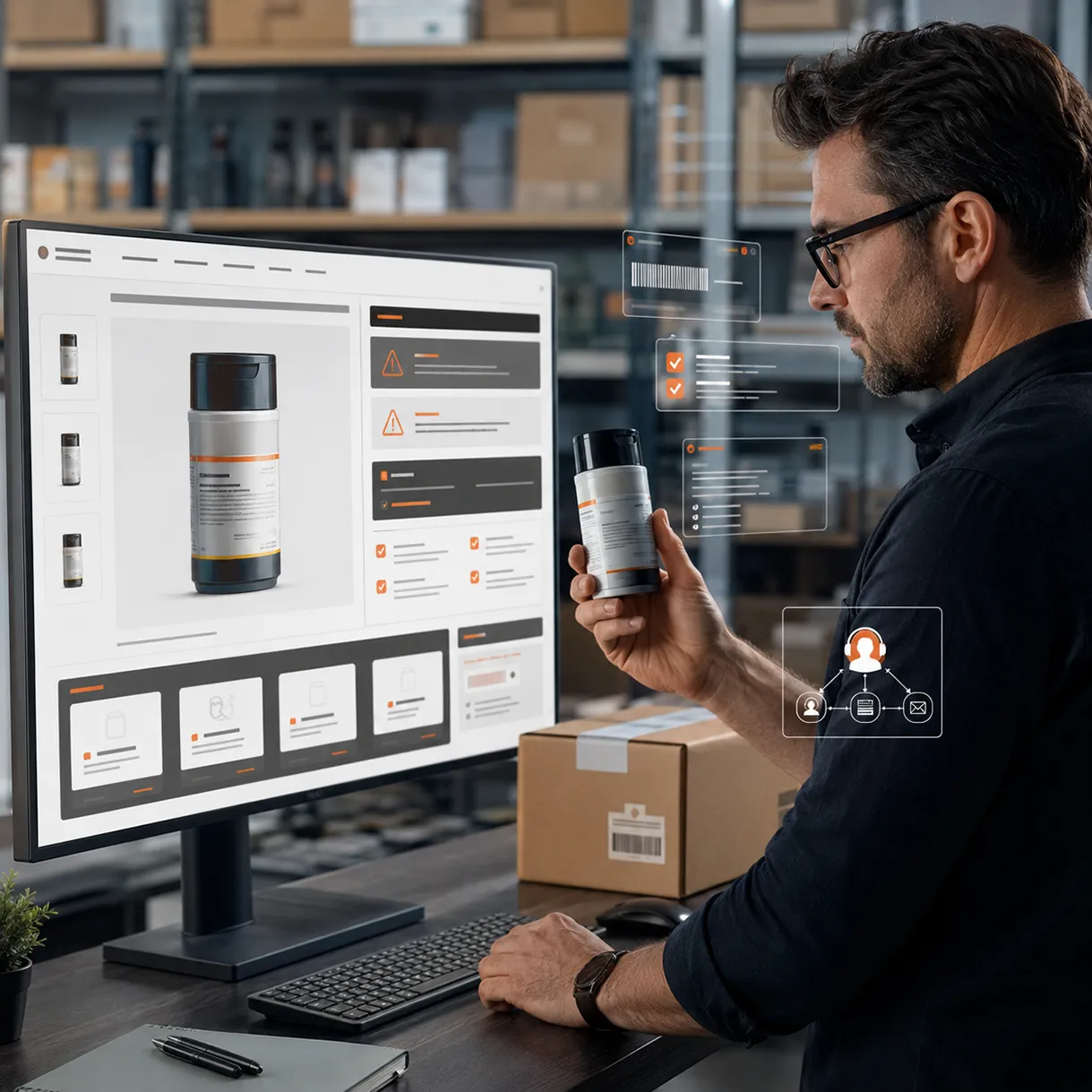
For you, this means: product safety is no longer just an issue for large manufacturers. Even if you sell products through an online shop, Shopify, Amazon, Etsy or other platforms, you must make certain information visible. This includes manufacturer details, product identification, warnings and clear processes for complaints or recalls.
This article shows you what the GPSR means in concrete terms. You will learn which obligations are important for product pages, labels and internal processes. In addition, you will receive practical examples, a compact table and clear recommendations for action for your shop.
What is GPSR?
GPSR stands for General Product Safety Regulation. In German, it is referred to as the EU Product Safety Regulation. This refers to Regulation (EU) 2023/988 on general product safety. It specifies that only safe consumer products may be made available on the EU market.
The GPSR applies to many products that consumers buy or use. These include, for example, clothing, furniture, decorative items, household goods, toys, accessories or many non-food consumer goods. Specific product rules, for example for toys or electrical devices, remain additionally relevant. The GPSR often acts as a basic safety net.
Online retail is particularly important. The regulation explicitly takes into account that products are often sold today through shops, marketplaces and international platforms. Therefore, safety-relevant information must already be available before purchase. Buyers should be able to recognize who is responsible for a product and which instructions apply.
Simply put: The GPSR forces you to organize product safety in a visible, understandable and documented way. It affects not only the product itself, but also your product page, packaging, labeling and internal processes.
Why is the GPSR important?
The GPSR is important because it creates trust and reduces risks in commerce. Today, consumers often buy products without knowing the manufacturer, origin or material quality in detail. Especially in e-commerce, direct consultation, physical product inspection and personal follow-up questions are missing. That is why product information must be clearer, more complete and easier to find online.
For you as a retailer or brand, it is not just about legal certainty. It is also about conversion, trust and a professional brand presence. If your product pages are properly maintained, you reduce uncertainty during the purchase process. Clear information about the manufacturer, product features and safety instructions strengthens your credibility.
The GPSR is also relevant from an SEO and AI perspective. Search engines and AI search systems prefer structured, clear and trustworthy content. If your product pages contain precise information, Google, ChatGPT, Perplexity or other systems can better understand your content.
This applies primarily to areas such as:
| Field | Why it's important |
|---|---|
| Product pages | Users can find important safety information before making a purchase. |
| Labels | Products remain clearly identifiable even after purchase. |
| Traceability | Affected batches can be identified more quickly in the event of problems. |
| Customer service | Complaints and safety reports are handled systematically. |
| Trust | Transparent information strengthens the brand and influences purchasing decisions. |
For many shops, this creates additional effort. At the same time, the GPSR offers an opportunity. Those who work cleanly early on can stand out from unprofessional providers.
How GPSR works in practice
What information should be included on your product page?
Your product page should contain all safety-relevant information that buyers need before placing an order. This mainly includes the name and address of the manufacturer or importer. In addition, you should provide clear product identification where relevant. This can be a model number, serial number, item number or batch information.
Also, warnings, age information or instructions for use belong visibly on the product page. For example, if you sell decorations with small parts, a warning about swallowable parts may be necessary. For children’s products, electrical items or products with specific risks, you should check especially carefully.
A good structure for product pages might look like this:
- Product name and clear product description
- Manufacturer or importer with full address
- Responsible economic operator in the EU, if applicable
- Model number, serial number, or lot number
- Safety and Warning Information
- Instructions for use in the appropriate language
- Link to the user manual or safety data
- A separate section titled “Product Safety”
The section “product safety” in particular helps users and search engines. It makes clear that you do not hide important information. It also improves the semantic structure of your product page.
What information must appear on the label and packaging?
The GPSR does not only affect your shop. The product, packaging or accompanying documents must also contain important information. This includes the manufacturer’s name, address and contact details. For manufacturers outside the EU, a responsible economic operator in the EU often has to be specified.
You also need a clear product identification. It helps assign products to specific batches in the event of complaints, safety reports or recalls.
Typical examples include:
| Task | Example |
|---|---|
| Manufacturer Name | Sample Co. |
| Address | 1 Main Street, 80331 Munich |
| Contact | Email or Website Contact |
| Product ID | Model number, serial number, or lot number |
| Warning | Not suitable for children under 3 years of age |
| Language | German for the German Market |
Important: The GPSR does not replace all specific rules. Additional regulations apply to certain product groups. This includes, for example, CE marking, toy warnings, electrical appliances, cosmetics or hazardous substances. Therefore, always check whether your product falls under further specific legislation.
How do you set up internal processes?
Many companies first think of product pages and labels. However, GPSR compliance does not end with visible information. You also need internal processes. These include risk analysis, technical documentation, complaint management and recall planning. A simple practical structure can look like this:
Step 1: Check product inventory
Create a list of all products you sell. Mark products with increased risk. These include children’s products, electrical items, products with small parts, chemical components or direct body contact.
Step 2: Gather product information
Collect manufacturer information, importer details, product numbers, warnings, and user manuals. Check to see if this information is up-to-date and complete.
Step 3: Update product pages
Add missing information to your shop. Use clear headings and structured sections. Avoid hiding information in PDFs if important notes should appear directly on the product page.
Step 4: Check labels and packaging
Compare shop information with the packaging and label. Both areas should fit together logically. Discrepancies appear unprofessional and can be problematic during inspections.
Step 5: Document symptoms
Determine how complaints are recorded. Note the product, order number, problem, date, and response. This will help you identify recurring patterns sooner.
Step 6: Prepare the callback process
Define who makes internal decisions when a security issue arises. Create templates for customer notifications, reports to regulatory authorities, and store suspensions.
What tools can help with implementation?
You do not necessarily need a complex system. For smaller shops, a clean workflow is often enough. Larger shops should integrate the GPSR more strongly into product data management, quality management and customer service.
Useful tools include:
- PIM System for Structured Product Data
- ERP System for Batches and Inventory Movements
- Ticket System for Complaints
- Checklists in Notion, Asana or Trello
- Shop Fields for Manufacturers and Safety Instructions
- Templates for Recall Communications
- Schema markup for structured product information
This work is also worthwhile from an online marketing perspective. Good product data does not only improve compliance. It also improves the user experience, internal search, Google Shopping, SEO and AI readability.
Opportunities and Risks of the GPSR
The GPSR brings clear challenges. It creates additional effort, especially with large product catalogs. Each item must be checked, maintained and documented. Missing manufacturer information, incorrect warnings or outdated product data can quickly become a problem.
At the same time, opportunities arise. Shops with clean product information appear more credible. Users are more likely to trust a brand that transparently explains who is behind a product and which safety information applies.
What are the risks of noncompliance?
In the event of violations of the GPSR, fines, sales bans, recall costs and reputational damage may be threatened. The specific design of the sanctions is carried out by the Member States. The penalties must be effective, proportionate and dissuasive.
It becomes particularly critical if an unsafe product continues to be sold. Missing traceability can also become expensive. If you cannot identify affected batches, a recall becomes unnecessarily expensive and imprecise.
Typical risk scenarios include:
- Product pages without manufacturer information
- Missing importer address
- No information provided regarding the person responsible in the EU
- Incomplete warnings
- Incorrect language in user manuals
- Missing product identification
- no documented complaint process
- Delayed response to security alerts
What opportunities will this create for your store?
The GPSR can improve your product communication. If you structure safety information properly, better product pages are created. These pages answer more questions, reduce uncertainty and can lower purchase abandonment.
For SEO and GEO, this is particularly interesting. AI search systems do not evaluate content only based on keywords. They analyze context, entities, trust signals and information density. A product page with manufacturer information, a safety section, FAQs and structured data is easier for machines to interpret.
This also supports your online marketing strategy. Email marketing can communicate safety updates or product information clearly. Performance marketing benefits from trustworthy landing pages. SEO benefits from clear information architectures.
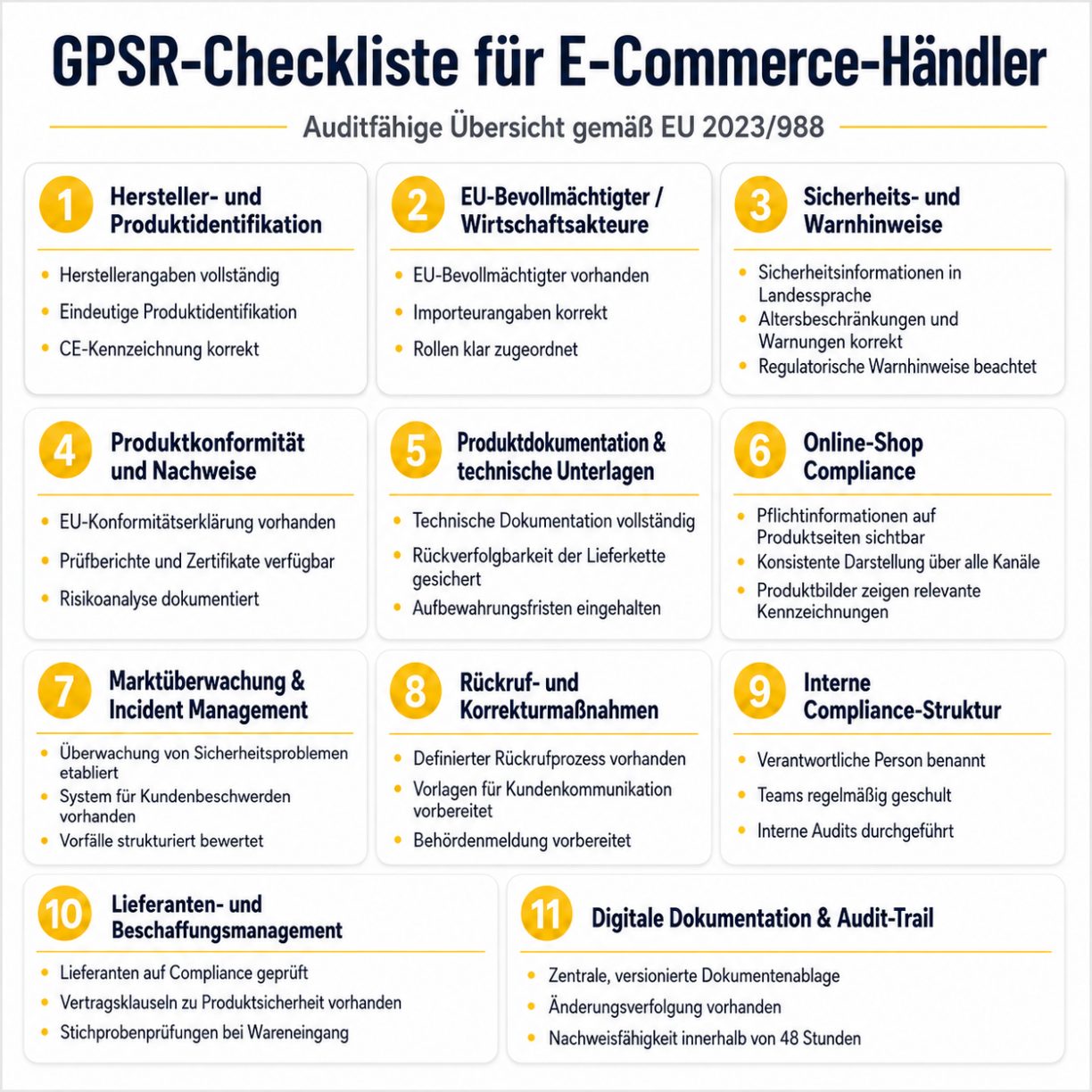
The checklist
The Future of the GPSR
The GPSR shows where e-commerce is heading. online retail is becoming more transparent, more heavily regulated and more data-driven. Product information is no longer understood only as sales copy. It is becoming a central building block for safety, trust and digital visibility.
In the future, product data will become even more important. Shops need structured information, clear responsibilities and fast update processes. Anyone who sells many products should no longer maintain product data manually on the side. Instead, clear workflows are needed between purchasing, marketing, legal, customer service and web development.
Artificial intelligence will also play a larger role. AI systems can check product data, identify missing information or formulate warnings more consistently. Nevertheless, human review remains indispensable. Legal responsibility cannot be fully automated.
For brands, this means: compliance, UX and SEO are growing closer together. A good product page must inform, sell, support legal requirements and be understood by AI systems. This is exactly where a strategic advantage for professional shops emerges.
Conclusion: GPSR is more than just a mandatory task
The GPSR is not a minor detail in online retail. It affects product pages, labels, packaging, internal processes and your entire product communication. Anyone who sells consumer products in the EU should take the requirements seriously and implement them systematically.
For you, however, the GPSR also offers an opportunity. Clean product information creates trust, improves the user experience and strengthens your visibility in search engines and AI search systems. If you think of product data, SEO, UX and compliance together, a clear competitive advantage emerges.
Media Beats supports you in translating complex requirements into understandable digital processes. Whether online shop, product pages, SEO, email marketing or performance marketing: A clear strategy helps you meaningfully combine legal requirements and digital growth.
Frequently asked questions about GPSR
GPSR stands for General Product Safety Regulation. This refers to EU Regulation 2023/988 on general product safety.
The GPSR has been directly applicable in the European Union since December 13, 2024.
Yes. Even small online stores can be affected if they sell consumer products in the EU.
Important information includes manufacturer or importer details, product identification, safety information, warnings, and instructions for use.
Yes. Comprehensive product information improves trust, structure, user experience, and machine readability.
Our blog
Latest news
With our blog, you are always close to our work, our current projects and the latest trends and developments in web and print.





Any questions?