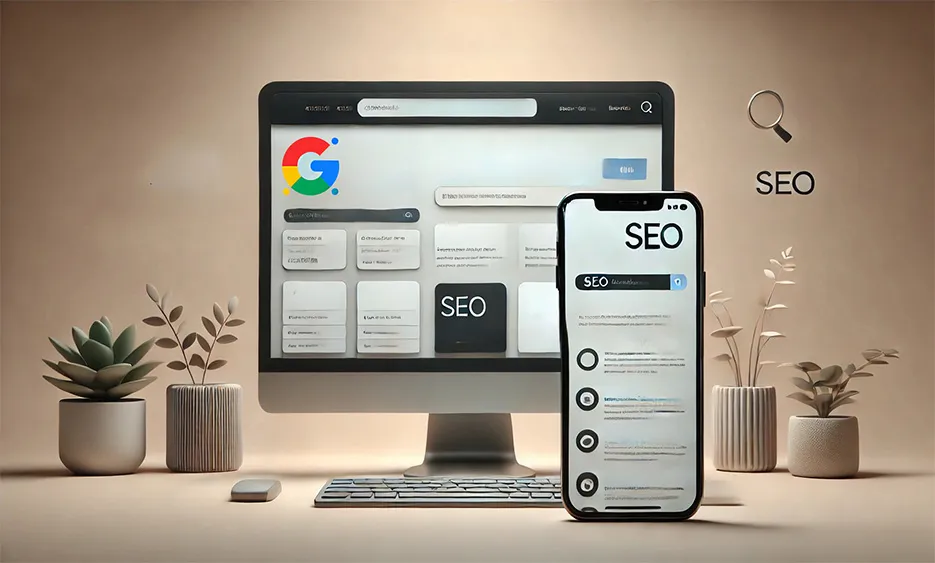
SEO strategies: How to achieve a higher ranking on Google
19. September 2024
In today’s internet landscape, well-thought-out SEO strategies are crucial for a higher Google ranking and the success of a website. The first search results receive the majority of the traffic. Those who don’t make it to the first page often remain unseen. That’s why SEO, or search engine optimization, has become one of the most important disciplines in online marketing. A full-service agency or a company with an effective SEO strategy can significantly improve visibility. This not only helps them gain more customers but also sustainably increases their revenue.
This article shows you 15 essential steps you should follow to achieve a better Google ranking. This way, you can remain successful in the long term.
1. Improve on-site SEO
On-site SEO encompasses all measures that you implement directly on your website to increase visibility. This primarily includes optimising content, metadata and page structure. A clearly structured website with logical headings (H1, H2, H3) makes it easier for Google to understand your content. The content should be well researched, relevant and of high quality in order to offer users real added value. User-friendliness also plays an important role. Websites with fast loading times, easy navigation and good mobile optimisation are rated higher by Google.
2. Monitor your technical SEO
Technical SEO includes all backend measures of your website that ensure search engines can easily crawl and index it. This includes setting up an XML sitemap as well as a well-configured Robots.txt file. You should also make sure that your website uses HTTPS, as Google prefers SSL-encrypted pages. Errors such as 404 pages or duplicate content should be detected and fixed with tools like Google Search Console. Mobile optimization is also crucial, as Google uses the Mobile-First Index and evaluates websites based on their mobile usability.
3. Find more keywords
A solid keyword strategy as part of your SEO approach is crucial to rank higher on Google. In addition to main keywords, you should also consider long-tail keywords, as these often have less competition. Such keywords help you reach niche audiences and generate qualified traffic. Use tools like the Google Keyword Planner to analyze search volume and competition for specific keywords. The keyword strategy should remain dynamic, as search trends constantly change. Regular competitor analysis can also uncover new keywords that your competitors are not sufficiently targeting.
4. Add LSI keywords
LSI keywords (Latent Semantic Indexing) are terms that are thematically related to your main keyword and clarify the context of your content. Instead of repeating a keyword unnecessarily often, LSI keywords can increase the relevance and variety of your content. These terms help Google better understand and evaluate your page. For example, if you are writing about “online marketing,” LSI keywords such as “digital marketing,” “SEO,” or “performance marketing” could be used. This strengthens the context and at the same time improves readability for the user.
5. Tailor your content to the search intent
Die Suchintention erklärt, warum ein Nutzer eine bestimmte Suchanfrage stellt. Sie können Ihre Inhalte nur optimal gestalten, wenn Sie wissen, was der Nutzer erreichen möchte. Es gibt grundsätzlich drei Arten von Suchintentionen: informationell, transaktional und navigational. Informationelle Anfragen dienen dem Wissensgewinn, transaktionale dem Kauf oder einer Aktion. Navigationale Suchanfragen führen den Nutzer zu einer spezifischen Website. Wenn Sie Ihre Inhalte an die Suchintention anpassen, werden sie für den Nutzer relevanter und sprechen seine Bedürfnisse direkt an. Analysieren Sie die Top-Rankings Ihrer Ziel-Keywords, um zu verstehen, welche Inhalte Google bevorzugt. Basierend darauf können Sie dann eigene, optimierte Inhalte erstellen.
6. Optimise for RankBrain
RankBrain is Google’s machine learning system that interprets search queries and finds the most relevant results for the user. It not only evaluates the content of your page but also how users interact with your website. An important signal is dwell time—the longer a user stays, the more valuable the page appears. To impress RankBrain, you should create content that is both informative and engaging. You should also keep the bounce rate low by offering intuitive navigation and clear calls-to-action (calls-to-action).
7. Create comprehensive content
Umfassende Inhalte, die ein Thema vollständig behandeln, haben eine höhere Chance, von Google als wertvoll bewertet zu werden. Diese Inhalte, oft „Longform Content“ genannt, sind in der Regel ausführlicher als typische Blogposts. Sie bieten dem Nutzer tiefere Einblicke und beantworten viele Fragen rund um ein Thema. Google belohnt solche Inhalte, da sie Nutzern helfen, umfangreiche Informationen zu erhalten, ohne die Seite zu verlassen. Ein Beispiel wäre ein 2000-Wörter-Leitfaden zum Thema „Online Marketing“, der sowohl Grundlagen als auch fortgeschrittene Strategien abdeckt.
8. Build high-quality backlinks
Backlinks are among the most important ranking factors on Google. When trustworthy sites link to your content, Google sees this as a positive signal. As a result, Google ranks your website as more relevant. However, quality matters more than quantity. Collecting many links from low-quality sites brings little benefit. Instead, you should focus on backlinks from high-quality, thematically relevant websites. A proven strategy to earn valuable backlinks is creating “linkable assets.” These are pieces of content so valuable that other sites want to link to them voluntarily.
9. Link your pages internally
Interne Verlinkungen sind ein wichtiger SEO-Faktor, da sie den Nutzern helfen, sich besser auf Ihrer Website zurechtzufinden. Sie erleichtern auch Google das Verständnis für den Zusammenhang zwischen verschiedenen Seiten. Wenn Sie thematisch verwandte Inhalte haben, sollten Sie diese unbedingt miteinander verlinken. Zudem erhöhen interne Links die Verweildauer der Nutzer, da sie länger auf Ihrer Seite bleiben und weiter navigieren. Achten Sie dabei immer darauf, dass die internen Links natürlich wirken und dem Nutzer echten Mehrwert bieten.
10. Build trust (E-A-T)
E-A-T steht für Expertise, Authoritativeness und Trustworthiness, also Fachwissen, Autorität und Vertrauenswürdigkeit. Google legt bei sensiblen Themen wie Gesundheit und Finanzen besonderen Wert auf vertrauenswürdige Inhalte. Um diese Kriterien zu erfüllen, sollten Sie klare Informationen zu den Autoren bereitstellen und externe, verlässliche Quellen nutzen. Prüfen Sie zudem regelmäßig Ihre Inhalte auf Aktualität, um stets verlässliche Informationen zu bieten. Positive Bewertungen und Testimonials können ebenfalls helfen, das Vertrauen in Ihre Website zu steigern.
11. Reduce the bounce rate
A high bounce rate signals to Google that users did not find what they expected. This negatively affects your ranking. To reduce the bounce rate, your content should be relevant, clear, and well-structured. Also integrate clear calls-to-action so that users know what steps to take next. Visual elements such as images and videos can also help capture users’ attention and keep them on the page longer.
12. Improve your click-through rate (CTR)
The CTR shows how often users click on your search result after it is displayed to them. A low CTR may indicate that your meta titles or descriptions are not compelling enough. To improve the CTR, create engaging and concise titles that clearly highlight the main benefits of your content. Meta descriptions should also be written in a way that sparks interest and shows users why it is worthwhile to click on your result.
13. Optimise for image search
Images are particularly important for Google image searches and contribute to SEO. To optimise your images, use relevant alt text that describes the image and contains important keywords. Make sure that the image files are not too large, so as not to slow down the page loading times. The file name should also clearly reflect the subject of the image so that Google can better recognise it.
14. Optimise your website for mobile use
As more and more people access websites via mobile devices, optimisation for mobile devices is essential. Google uses the mobile-first index, which means that the mobile version of your website is given priority in its rankings. Make sure that your site looks good and loads quickly on different devices. A responsive design that automatically adapts to the screen size is particularly important for optimal display and user experience.
15. Improve your website's loading speed
The loading speed of your website is an important ranking factor, as users expect pages to load quickly. If users leave the page too early, it has a negative impact. To improve loading times, compress images, remove unnecessary plugins, and use tools like Google PageSpeed Insights. These help identify potential issues quickly. A fast website not only provides a better user experience but is also ranked higher by Google.
Conclusion
Improving your Google ranking requires a well-thought-out strategy and constant optimization. From keyword strategy to technical SEO aspects to high-quality content—many factors influence your visibility. A successful SEO strategy combines technical sophistication with content quality. By following these 15 steps, you create a solid foundation for better placement in Google search results. This way, you ensure long-term success in online marketing and sustainably increase your reach.
If you would like to make use of these services or learn more about them, contact us here.
Our blog
Latest news
With our blog, you are always close to our work, our current projects and the latest trends and developments in web and print.



Any questions?