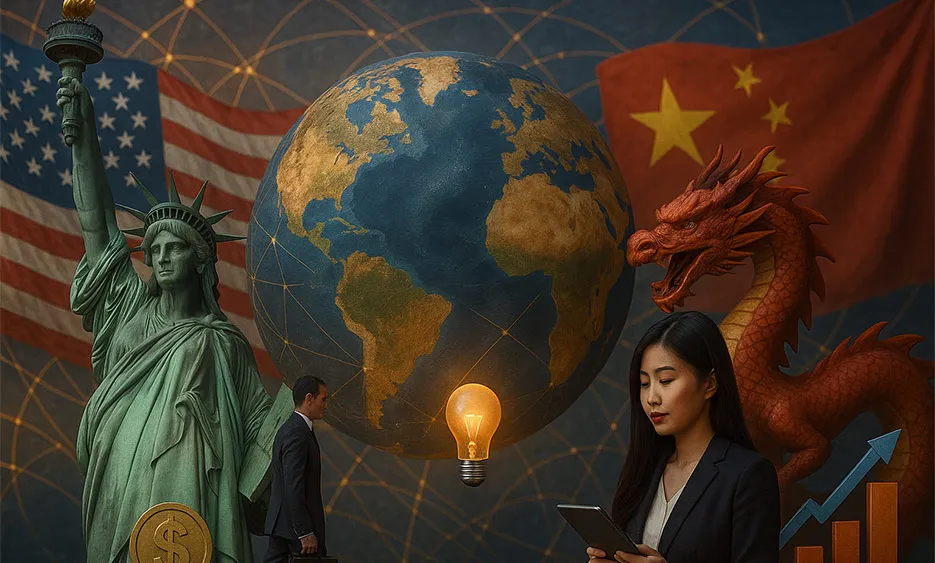
The US and China: The global competition for hearts, minds, and wallets
April 29, 2025
USA and China – The strategic rivalry has long gone beyond geopolitical and military competition. It is evolving into a multifaceted battle for global influence and is steadily gaining importance. This competition now encompasses soft power, economic relations, as well as cultural appeal and digital dominance alike.
The following article provides a comprehensive analysis and highlights how both superpowers strategically build their positions. Both are determined to win the hearts, minds, and wallets of the global community in a sustainable way.
The rivalry of soft power
The use of soft power, which relies on attraction and persuasion rather than coercion, is gaining significant importance. It has become a crucial arena in the strategic competition between the USA and China. China now assigns soft power as much importance as its military and economic strength.
China’s leadership increasingly views soft power as a central instrument for its global ambitions and interests. Beijing’s focus on soft power continues to grow, as the Asian nation seeks to convince the world of its peaceful intentions. At the same time, China strives to credibly demonstrate its commitment to sustainable and peaceful development.
China has become a major player in the field of soft power thanks to several key factors:
- Robust economic growth
- The ambitious Belt and Road Initiative (BRI)
- Resolving conflicts with neighboring countries
- Rapid technological progress
- Substantial contributions to UN peacekeeping missions
Despite these efforts, China continues to face significant challenges regarding its international image in Western countries. The USA and its allies are actively trying to systematically weaken Chinese soft power through targeted criticism.
They portray the Belt and Road Initiative as a “debt trap” and point to human rights violations in China. They also criticize China’s authoritarian governance model and publicly highlight alleged labor exploitation in Africa.
At the same time, the USA traditionally leverages its extensive network of international rules and institutions to exert global influence. They use these instruments strategically to assume global leadership and promote American values. Nevertheless, the effectiveness of this approach has been inconsistent and faced criticism during President Trump’s first term. During that period, the USA withdrew from several international commitments, potentially weakening its credibility.
Economic strategies and global influence
Trump's trade policy
Recent developments in U.S. trade policy mark a significant turning point and could alter America’s global influence. In April 2025, President Trump announced the so-called “Liberation Day” tariffs, introducing new trade barriers. These include a general import tax of 10% as well as targeted “reciprocal” tariffs against key trading partners.
The measures represent the highest trade barriers since 1909 and affect numerous major economies. Particularly high tariffs target Vietnam at 46%, Japan at 24%, South Korea at 25%, and the European Union at 20%. Even Canada and Mexico, America’s neighbors and trading partners, must endure substantial new tariffs.
These tariffs act as an additional cost factor and place a heavy burden on both American businesses and consumers. The effects ripple across supply chains and impact many sectors in the United States. They range from car purchases in Detroit to household appliance sales in Dallas and construction projects in Denver.
The international response came quickly and sparked widespread concern. The European Union immediately began planning possible countermeasures against U.S. trade policy. France’s President Macron explicitly urged European companies to completely halt investments in the United States. At the same time, Canada’s Prime Minister Mark Carney declared that “our old relationship of steadily deepening integration with the United States is over.” Whether all this will remain the case is still unclear at this point.
China’s Belt-and-Road-Initiative
In contrast to America’s goal-oriented approach, China has established the Belt and Road Initiative as a cornerstone of its economic policy. The BRI involves massive investments in other countries’ infrastructure, thereby significantly expanding China’s economic reach. At the same time, China improves its international image through the BRI and strengthens its position as a global economic power.
By presenting the BRI as a win-win cooperation model, China positions itself as a “responsible power” in the global community. This initiative strategically strengthens China’s economic influence and builds positive perceptions among participating nations. Especially in developing countries, China fosters trust and long-term partnerships.
Cultural factors in global influence
Communication styles
The contrasting communication styles of Americans and Chinese form a fundamental aspect of their international relations. They play a crucial role in how both countries strategically build influence worldwide and pursue their interests. American communication is typically:
- Direct and explicit
- Problem-solving oriented
- Informal in approach
- Convincing in nature
Americans usually present important information first, starting with the conclusions. They then provide supporting details to make their reasoning coherent and easy to follow. In business, they prefer to state their key points clearly and directly right away. After that, they actively negotiate with their partners by testing and comparing different solutions. They deliberately try various approaches before ultimately reaching a final outcome.
Chinese communication, on the other hand, is characterized by the following features:
- Building context before the main points
- Formal interactions, especially with strangers or people of higher status
- Thorough understanding of the problem before seeking solutions
- Tendency to express trends, expectations, and goals rather than just facts
These fundamental differences significantly shape how each nation exerts and is perceived in terms of global influence. American directness is appreciated in some cultural contexts and interpreted as a sign of openness.
In other regions, however, it can come across as harsh or culturally insensitive and may face rejection. The Chinese communication style is often positively perceived for its richness in context and consideration. In the West, however, it is frequently seen as too indirect or inefficient, leading to misunderstandings.
Marketing approaches
The contrasting marketing strategies of American and Chinese companies reflect deeper cultural values and shape their brand positioning. In China, Confucian values such as community and collectivism influence marketing and its direction. Chinese brands focus on building a strong sense of belonging within their target audiences. They routinely incorporate cultural symbols and collective values into their advertising campaigns. For example, ads for the Chinese New Year often highlight family reunions and shared joy.
In contrast, American marketing reflects the country’s individualistic culture and highlights personal achievements. It emphasizes freedom, self-realization, and individual benefits for the consumer. Campaigns are designed to deliberately resonate with the personal aspirations and experiences of the target audience. In doing so, they consistently embody the narrative and spirit of the American Dream.
International cooperation and global governance
The withdrawal of the US from international organizations
President Trump’s second term could further advance the withdrawal from and questioning of international organizations. This would significantly weaken U.S. global leadership and spread uncertainty. Abandoning international commitments could noticeably affect America’s position in its competition with China. At the same time, there is a risk that the United States’ reputation among allies and partners could suffer lasting damage.China’s Participation in Global Governance
China has actively expanded and strategically strengthened its participation in the United Nations and other international organizations. This allows China to deliberately present itself as a leading player within the international community and gain prestige. This active involvement enables China to credibly position itself as a responsible global power while systematically expanding its influence on international norms and standards.
China can increasingly influence international norms in its favor by actively shaping global governance structures. At the same time, the country presents itself as an advocate of a multilateral order and strengthens its role in world politics. Especially when the United States withdraws from such frameworks, China consistently takes advantage of the resulting opportunities.
Conclusion
The competition between the USA and China for global influence represents a complex and multidimensional challenge. It goes far beyond traditional power politics and requires new strategies as well as flexible approaches from both superpowers. Each nation pursues different strategies that clearly reflect its cultural values, economic models, and geopolitical objectives.
China’s approach emphasizes development cooperation, cultural diplomacy, and increased participation in global governance. At the same time, China strategically leverages its growing economic power to continuously expand its global influence. The United States relies on its traditional leadership role, democratic values, and established global networks. However, political shifts toward protectionism and international isolation could increasingly jeopardize these traditional advantages.
The ultimate winner in this competition may not be determined solely by military or economic strength. Rather, it will depend on the ability to credibly address the true needs and aspirations of the global community. The strategic decisions of both nations will shape global perceptions in the future and significantly influence their respective spheres of influence. International cooperation, economic relations, and cultural diplomacy will play a decisive role in this process.
Learn more about how to strategically and successfully position your brand for online visibility in the global market. Feel free to contact us for tailored online marketing strategies that reach your target audiences worldwide.

Sources:
- https://www.nzinitiative.org.nz/reports-and-media/opinion/the-art-of-the-fail/
- https://ojs.jssr.org.pk/index.php/jssr/article/download/288/226/2138
- https://gab-china.com/marketing-in-china-vs-us-navigating-the-cross-cultural-marketing-maze/
- https://francis-press.com/uploads/papers/58k7GcyYYAuKhsAGdYKwaeR8uFsDWiSu37vNargC.pdf
- https://www.ucigcc.org/blog/how-america-first-aids-chinas-global-influence/
- https://www.imd.org/news/competitiveness/updates-china-us-pursuing-markedly-different-but-equally-competitive-digital-transformations-wcc/
- https://globalaffairs.org/commentary-and-analysis/blogs/us-china-competition-global-opinion
- https://www.cfr.org/timeline/us-china-relations
- https://www.cnn.com/2023/11/13/us/china-online-disinformation-invs/index.html
- https://www.globalasia.org/v16no4/cover/head-versus-heart-us-china-soft-power-competition-over-values_maria-repnikova
- https://www.wifa.uni-leipzig.de/en/sept-competence-center/veranstaltungsdetail-sept/event/online-marketing-challenge-2024
- https://ketagalanmedia.com/2025/03/31/chinas-digital-propaganda-machinery-how-beijing-is-reshaping-the-global-discourse-in-the-2020s/
- http://en.nads.ruc.edu.cn/Banner/0e8346795acf433ca5e2aaff741c52c4.htm
- https://www.ewadirect.com/proceedings/chr/article/view/15083
- https://www.reuters.com/world/china/china-censors-some-tariff-related-content-social-media-2025-04-09/
- https://www.9dashline.com/article/soft-power-through-connectivity-how-do-china-and-the-us-compare
- https://www.scmp.com/opinion/article/3281927/better-ways-us-win-hearts-and-minds
- https://business.cornell.edu/hub/2020/02/18/impact-e-commerce-china-united-states/
- https://www.countrynavigator.com/blog/10-cultural-differences-china-and-the-us
- https://www.swp-berlin.org/10.18449/2020RP04/
- https://www.iab.com/wp-content/uploads/2016/11/IAB-US-China-Digital-Commerce-Study_FINAL.pdf
- https://www.uscc.gov/sites/default/files/2020-12/Chapter_1_Section_1–A_Global_Contest_for_Power_and_Influence.pdf
- https://www.cnn.com/2025/04/10/business/us-trade-war-china-escalation-analysis-intl-hnk/index.html
- https://www.reddit.com/r/centrist/comments/1ifgw4a/can_someone_plainly_explain_trumps_obsession_with/
- https://fpif.org/soft-power-divide-china-advances-while-u-s-retreats/
- https://seeders.com/blog/online-marketing-china/
- https://www.iosax.de/angebot/omc/
- https://digitalcommons.liberty.edu/cgi/viewcontent.cgi?article=1206&context=jspp
- https://uscpublicdiplomacy.org/blog/chinese-soft-power-and-public-diplomacy-united-states
- https://www.agenzianova.com/en/news/china-tightens-tariffs-online-attacks-on-usa-grow-on-social-media/
- https://jordantimes.com/opinion/shehab-al-makahleh/soft-power-showdown-us-vs-china
- https://www.gomachallenge.com
- https://warontherocks.com/2024/08/chinas-global-public-opinion-war-with-the-united-states-and-the-west/
- https://www.csis.org/analysis/refocusing-us-public-diplomacy-multipolar-world
- https://www.kantar.com/Inspiration/Social-Media/US-versus-China-in-social-media-usage
Our blog
Latest news
With our blog, you are always close to our work, our current projects and the latest trends and developments in web and print.



Any questions?