
Full-Service Marketing Agencies in 2026: In Transition
21. October 2026
A full-service marketing agency combines strategy, SEO, performance marketing, and AI. Find out which services, costs, and future trends will be important in 2026…
Overview
- An analysis of modern full-service marketing agencies, their business models, services, market positioning, and competitive landscape in the DACH region.
- An examination of how artificial intelligence, automation, data-driven marketing, and changing customer expectations are transforming the agency industry.
- An assessment of profitable pricing models, efficient organizational structures, and strategic success factors for competitive full-service agencies through 2030.
Marketing is becoming more complex, but at the same time entirely new opportunities are emerging. Today, companies need to coordinate far more than individual advertising campaigns. Search engines, social media, artificial intelligence, and automated customer communication are changing the requirements for successful marketing.
A full-service marketing agency can solve these challenges. It connects different marketing disciplines and aligns them with shared business goals. Instead of isolated measures, this creates a strategy that combines brand building, customer acquisition, and long-term growth.
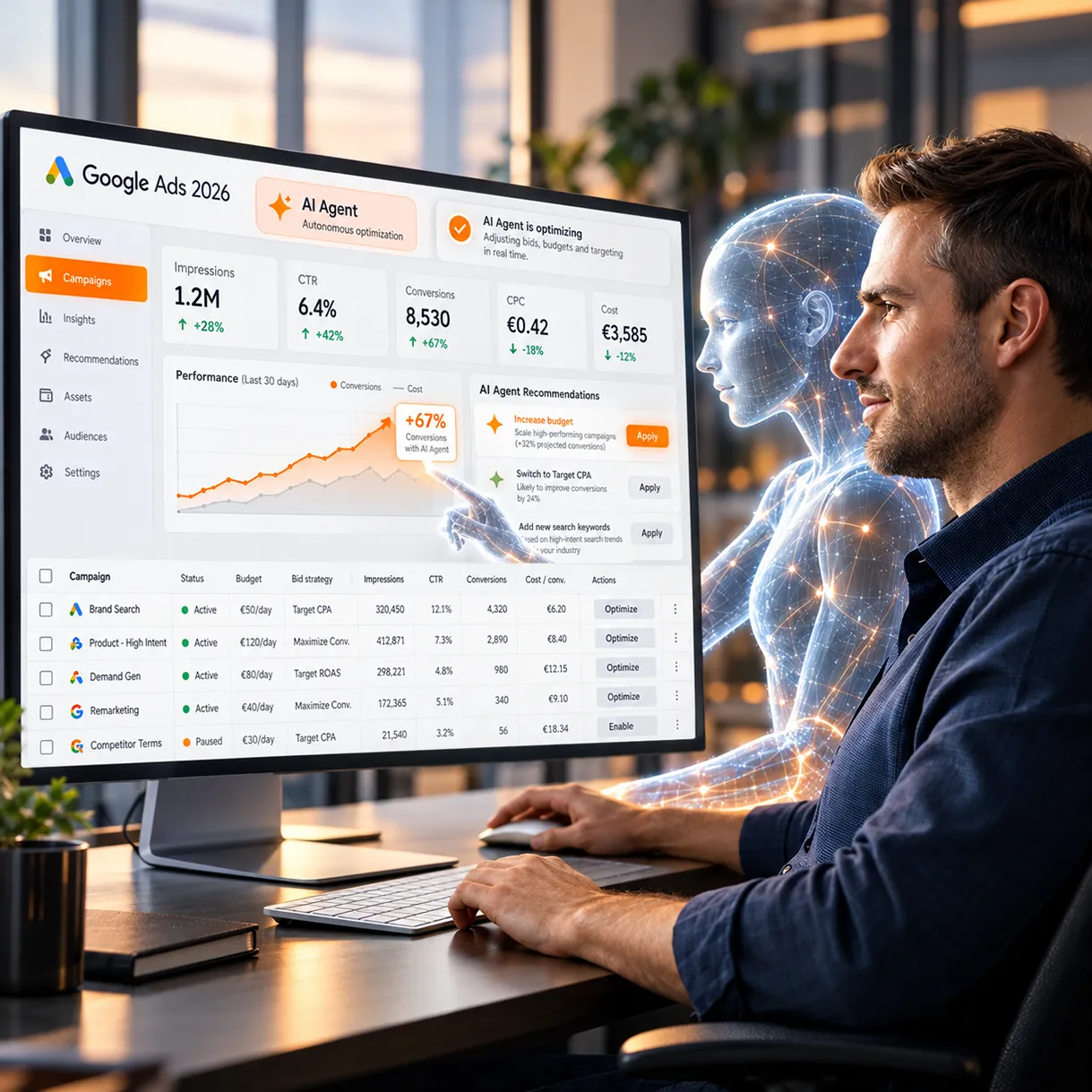
However, the traditional agency model is changing fundamentally. Artificial intelligence automates operational tasks, data is becoming increasingly important, and marketing decisions are being made with growing support from technology.
Today’s full-service marketing agency is therefore much more than a provider of advertising services. It is evolving into a strategic partner that brings together creativity, technology, and measurable results.
This raises important questions for you: Which services do you really need? When is an integrated agency worthwhile? And what impact do AI and automation have on costs and results?
In this article, you will learn how modern full-service agencies work and what advantages they offer. You will also learn what to look for when choosing an agency.
What is a full-service marketing agency?
A full-service marketing agency is a service provider that strategically and operationally connects different areas of marketing. These include, for example, search engine optimization, performance marketing, email marketing, social media, content, and web development.
The key difference from a specialized agency lies in the comprehensive support.
While an SEO agency mainly optimizes organic visibility, a full-service agency looks at your entire digital customer journey.
It analyzes how potential customers become aware of your company, search for information, and make purchase decisions. It then combines suitable channels into a unified marketing concept.
What sets modern full-service agencies apart from traditional advertising agencies?
Traditional advertising agencies often focused on campaign ideas, design, and media placement. Modern agencies take on additional tasks:
- Strategic planning and positioning
- Data Analysis and Performance Measurement
- Digital customer acquisition and customer retention
- Technical development and marketing automation
- AI-powered production and process optimization
Internationally, this development is particularly evident. The Serviceplan Group combines strategy, creativity, media, data, and technology in an integrated agency model.
Smaller companies can also benefit from this principle. What matters is not the size of the agency, but the collaboration between its specialist departments.
A modern full-service marketing agency like Media Beats therefore does not need to provide every specialized service in-house. However, it must professionally coordinate all measures and understand their combined impact.
Why are full-service marketing agencies important today?
The number of digital marketing channels is growing. At the same time, requirements for data protection, personalization, and measurable results are increasing. If you work with several service providers independently, different priorities can quickly emerge.
Your SEO agency, for example, optimizes organic rankings. At the same time, your performance team focuses on paid conversions. Without a shared strategy, important synergies may remain unused.
A full-service marketing agency, such as Media Beats, connects these activities and creates a unified view of your marketing efforts.
How can you benefit from integrated marketing?
1. Consistent marketing strategy
All activities pursue shared goals. This strengthens your brand positioning and helps you avoid conflicting messages.
2. More efficient collaboration
Central points of contact make decision-making easier. Information does not need to be constantly exchanged between different agencies.
3. Making better use of your data
Insights from search engine advertising can, for example, improve your SEO strategy. At the same time, CRM data provides valuable information for new campaigns.
4. More targeted budget allocation
You can prioritize marketing budgets based on shared business goals instead of optimizing individual channel metrics alone.
5. Faster implementation
Creative concepts, technical adjustments, and campaign optimizations can be coordinated more closely.
However, these benefits do not arise automatically. They require clear responsibilities, shared data, and structured processes.
What role does artificial intelligence play?
Artificial intelligence is accelerating the shift toward integrated marketing. According to the IAB Europe Impact of AI Report 2026, 86% of the organizations surveyed use AI in marketing.
In addition, 72% of respondents who provided relevant information reported increased overall AI investments compared with 2025.
These results show the growing importance of intelligent technologies. However, they come from an industry survey and do not automatically represent all companies.
For you, the practical application is what matters most: AI can accelerate analyses, prepare content, and support campaign processes. Strategic goals and quality decisions remain crucial.
What services does a full-service marketing agency offer?
A modern full-service marketing agency combines creative, technical, and analytical expertise. Which services actually make sense depends on your business model, your target audience, and your growth goals.
The individual areas reinforce one another. A high-quality blog article can, for example, attract organic visitors. An optimized landing page then guides interested users toward making contact.
With appropriate consent and relevant email content, existing contacts can be nurtured over the long term. This is precisely where the value of a holistic online marketing strategy lies.
How does a full-service marketing agency work in practice?
Successful integrated marketing doesn't start with choosing individual advertising platforms. First, you need to understand your business goals and available resources.
A professional process can be broken down into six steps.
Step 1: How do you analyze your current situation?
First, the agency reviews the current state of your marketing activities. This includes your website, visibility, campaign performance, competitive landscape, and existing customer data.
It then identifies potential weaknesses and opportunities for growth. It is particularly important to distinguish between symptoms and causes.
Low website traffic, for example, does not automatically mean that you need more advertising. You may be missing relevant content or a clear search engine strategy.
A well-founded analysis prevents you from investing your budget in unsuitable measures.
Step 2: How do you develop a joint strategy?
Based on the analysis, the agency defines specific goals. Possible goals include qualified leads, additional sales, greater brand awareness, or improved customer retention. Next, target audiences, messages, and communication channels are defined.
The customer journey also plays an important role. A potential customer needs different information during the initial research phase than immediately before a purchase decision. Your strategy should take these differences into account and provide suitable content.
Step 3: Which marketing channels should you combine?
Not every channel is suitable for every company. A professional full-service marketing agency selects measures based on target audience, demand, and cost-effectiveness.
Real-world example: A medium-sized B2B company wants to attract more qualified leads.
The strategy could look like this:
- SEO: Expert articles answer specific search queries from potential customers.
- Google Ads: Search campaigns reach potential customers with an immediate need.
- LinkedIn: Expert content strengthens trust and brand awareness.
- Landing pages: Clear offers make it easier to generate qualified inquiries.
- Email Marketing: Relevant information is sent to existing contacts.
- Analytics: Combined data reveals which actions generate valuable leads.
The greatest impact is achieved when these channels do not operate independently of one another. Insights from paid search campaigns can, for example, make additional content topics visible.
Step 4: How are campaigns and content implemented?
After strategic planning, operational implementation begins. Designers develop suitable advertising materials. Content specialists create copy, while performance experts set up campaigns.
Technical teams optimize landing pages, tracking, and required interfaces. At the same time, the coordinated production of different content formats is becoming increasingly important.
A central campaign idea can, for example, be used to create blog articles, social media posts, newsletters, and videos, while AI-powered tools support research, the development of variations, and technical processes.
Consistent quality control remains essential. Content must be factually accurate, easy to understand, and on-brand.
Step 5: How do you measure actual marketing success?
A professional agency does not evaluate clicks or reach alone. It examines how marketing activities contribute to your business goals. Different metrics can help with this:
| Service area | Typical tasks | Benefits for your business |
|---|---|---|
| Marketing strategy | Market analysis, positioning, target audiences | Clear focus |
| SEO & GEO | Search engine optimization, AI visibility, Content | Organic search visibility |
| SEA | Google ads, Campaign management | Specific demand |
| Performance marketing | Paid social, Conversion optimization | Measurable customer acquisition |
| Email marketing | Newsletters, CRM, Automation | Customer Loyalty |
| Social media | Content, Community, Social Ads | Reach and Brand building |
| Web design & UX | Websites, Landing pages, User guidance | Better user experience |
| Analytics & AI | Tracking, Reporting, Automation | Informed decisions |
The key is to interpret the data correctly. A high ROAS does not automatically prove that a campaign generated additional revenue.
Some customers might have purchased even without advertising. This is why controlled experiments and marketing mix modeling are becoming increasingly important. Google Meridian, for example, is an open-source framework that statistically estimates the incremental impact of marketing.
Step 6: How do you optimize your marketing for the long term?
After the campaign launch, continuous improvement begins. The agency analyzes results, tests new approaches, and adapts measures to changing conditions. New search queries, customer needs, or competitors can create additional opportunities.
Email marketing also plays an important role. Through segmentation and automation, existing customer relationships can be developed more strategically. Our article on email marketing as an underestimated growth channel shows the opportunities this can create.
How much does a full-service marketing agency cost?
The cost of a full-service marketing agency depends heavily on the scope of services. A company with only a few campaigns requires different resources than an internationally operating corporation.
Important cost factors include the number of channels managed, the technical effort, and the required expertise. Reporting, content production, and strategic consulting also influence the price.
What billing models are available?
Monthly retainer: You pay an agreed-upon amount for specific, recurring services.
Project-Based Compensation: A clearly defined project is assigned an agreed-upon total price.
Hourly compensation: Billing is based on the actual amount of work performed.
Performance-based components: A portion of the compensation is based on predefined results.
According to the Digital Agency Industry Report 2026 by Promethean Research, agencies often combine different pricing models. The study also reports that 29% of the agencies surveyed charge hourly rates between $175 and $199. However, these sample results do not represent a comprehensive overview of agency pricing in Germany.
The economic impact is more important than the lowest price.
Therefore, check which services are included and which team will actually be assigned to the project. You should consider advertising budgets, software licenses, and external production costs separately.
What opportunities and risks does a full-service marketing agency offer?
The integrated agency model opens up numerous possibilities. At the same time, it gives rise to new requirements for collaboration and oversight.
What opportunities will this create for your business?
- Holistic Management: Shared goals reduce the need for isolated, individual measures.
- Technological efficiency: Marketing automation and AI can accelerate recurring tasks.
- Consistent brand communication: Consistent messages strengthen brand recognition.
- Better scalability: Successful campaigns can be expanded across additional channels and target audiences.
- Stronger customer relationships: CRM and email marketing combine new customer acquisition with long-term customer retention.
What risks should you be aware of?
Comprehensive support can also create dependencies. If all marketing data and processes are held exclusively by one agency, switching providers later becomes more difficult. You should therefore ensure transparent access rights, traceable processes, and structured data handovers.
Additional challenges concern the quality of individual specialist areas. Not every agency has the same level of expertise across all disciplines.
AI also requires special attention. Automated systems can create inaccurate content or make unsuitable campaign decisions. In addition, data protection, copyright, and applicable AI regulations must be taken into account.
The EU AI Act has included additional applicable requirements since 2026. However, under the AI Omnibus, later deadlines apply to certain high-risk systems. The European Commission documents the changes and their implementation timeline.
What mistakes should you avoid when choosing an agency?
The most common mistakes occur before the contract is signed. In particular, avoid:
- Unclear marketing goals without measurable success criteria
- Decisions based solely on the offer price
- Lack of transparency regarding the actual project team
- Insufficient control over data and advertising accounts
- Lack of coordination between strategy and implementation
- Unrealistic promises of success with no verifiable basis
Request specific service descriptions, clear responsibilities, and regular reporting. A good full-service marketing agency clearly explains which measures make sense and what limitations exist.
What does the future hold for full-service marketing agencies?
The full-service marketing agency is increasingly evolving into a combination of consulting, technology, and creative production.
Development of the Full-Service Marketing Agency
From Traditional Web Agencies to AI-Powered Marketing Platforms
- Web agencies are emerging
- Digital strategy and web production are becoming distinct disciplines
- Scaling search, social, and digital media
- Performance data complements traditional creation
- Mobile-first
- Marketing automation and CRM are growing
- Programmatic is changing media buying
- Design, development, and marketing are converging
- First-Party Data and CDPs
- Privacy and identity transformation
- Commerce and customer experience take center stage
- Generative AI is becoming a production and analytics layer
- Agency platforms bring together creative, media, data, and tech
- The EU AI Act complements data protection governance
- Agentic Marketing und teilautonomes Media Buying
- Humans orchestrieren AI Agents statt einzelne Tasks
- Measurement verschiebt sich zu Incrementality und MMM
- Outcome-orientierte Commercials gewinnen an Bedeutung
- Agentur, Software, Consulting und Managed Service verschmelzen
← Zeitachse horizontal verschieben →
The outlook starting in 2026 highlights expected trends and possible future scenarios.
In particular, five developments are shaping this change.
1. AI agents take on operational tasks
AI agents can analyze data, create recommendations, and execute workflows within defined permissions. In marketing, this creates new opportunities for reporting, campaign management, and content production.
According to IAB Europe, 58% of the organizations surveyed expect agent-based ad buying to be operationally deployed or scaled within one year. This reflects respondents’ expectations and is not a guarantee of widespread adoption.
2. Data becomes a strategic competitive advantage
Own customer data is becoming increasingly important. Companies can use lawfully processed first-party data to develop more relevant content and improve customer relationships. Key factors include data quality, appropriate consents, and clear responsibilities.
3. AI is transforming content production
A single campaign idea can increasingly be developed into multiple formats and variations. This creates new opportunities for personalized advertising and continuous social media content. Nevertheless, creative ideas, brand understanding, and human oversight remain essential.
4. Agencies must provide better evidence of their results
Simply producing marketing activities is becoming increasingly insufficient in the long term. Companies need clear insights into the economic value generated by their investments. This is why experiments, cross-channel analyses, and shared performance metrics are becoming increasingly important.
5. Strategic consulting is gaining value
The more operational tasks are automated, the more important well-informed decisions become. A future-ready full-service marketing agency therefore does not need to offer as many tools as possible. It needs to understand how technology supports specific business goals.
FAQs about Full-service marketing agencies
What does a full-service marketing agency do?
A full-service marketing agency plans, coordinates, and optimizes various marketing activities from a single source. These include strategy, SEO, SEA, social media, email marketing, and performance marketing. The goal is a consistent, measurable marketing strategy that supports your business objectives.
Für welche Unternehmen lohnt sich eine Full-Service-Marketing-Agentur?
A full-service marketing agency is particularly suitable for companies that want to coordinate multiple marketing channels. Growing B2B and B2C companies can also benefit. Your goals, your budget, and the required expertise are the key factors.
Is a full-service agency better than several specialized agencies?
Not necessarily. A full-service agency provides centralized coordination and a shared strategic direction. Specialist agencies may offer greater expertise in individual areas. Which solution makes more sense depends on your requirements and available internal resources.
How is AI changing the work of full-service agencies?
AI supports data analysis, content production, automation, and campaign optimization. This can make certain processes faster. Strategy, creative quality, data protection, and the oversight of important decisions remain key responsibilities of experienced marketing experts.
Conclusion: Why integrated marketing is becoming essential
The full-service marketing agency is undergoing fundamental change. Traditional advertising services are increasingly being complemented by data analysis, automation, and artificial intelligence. This creates new opportunities for your company to better integrate its marketing activities.
However, strategic direction remains crucial. Individual tools, platforms, or campaigns do not guarantee sustainable success. Successful marketing requires clear goals, coordinated processes, and transparent performance measurement.
A professional full-service marketing agency can help you systematically meet these requirements. When choosing an agency, you should pay particular attention to expertise, transparency, and the quality of collaboration.
The future does not automatically belong to the agency with the broadest range of services. What matters is how effectively it combines different areas of expertise.
Do you want to strategically develop your online marketing and connect your marketing channels more efficiently? Media Beats supports you with integrated services in strategy, SEO, SEA, performance marketing, and email marketing. Contact us for a no-obligation consultation and find out which measures best support your business goals.
Our blog
Latest news
With our blog, you are always close to our work, our current projects and the latest trends and developments in web and print.



Any questions?