
Labeling AI-Generated Images: What the EU AI Act Requires
18. August 2026
When Do You Need to Label AI-Generated Images? Find out how Article 50 of the EU AI Act classifies deepfakes, AI avatars, and altered marketing content…
Overview
- You don't have to label every AI-generated image, but you should focus on deepfakes that might give the false impression of authenticity.
- You evaluate the use of AI, realism, message, publication context, and target audience expectations, and clearly disclose relevant content in accordance with Article 50.
- You build trust by establishing clear guidelines, accessible placements, and documented approval processes.
Do I have to label all AI images since August 2, 2026? No. This exact blanket assumption is currently leading to unnecessary notices and incorrect processes. The new AI labeling obligation under Art. 50 of the EU AI Act does not automatically apply to every AI-generated marketing visual.
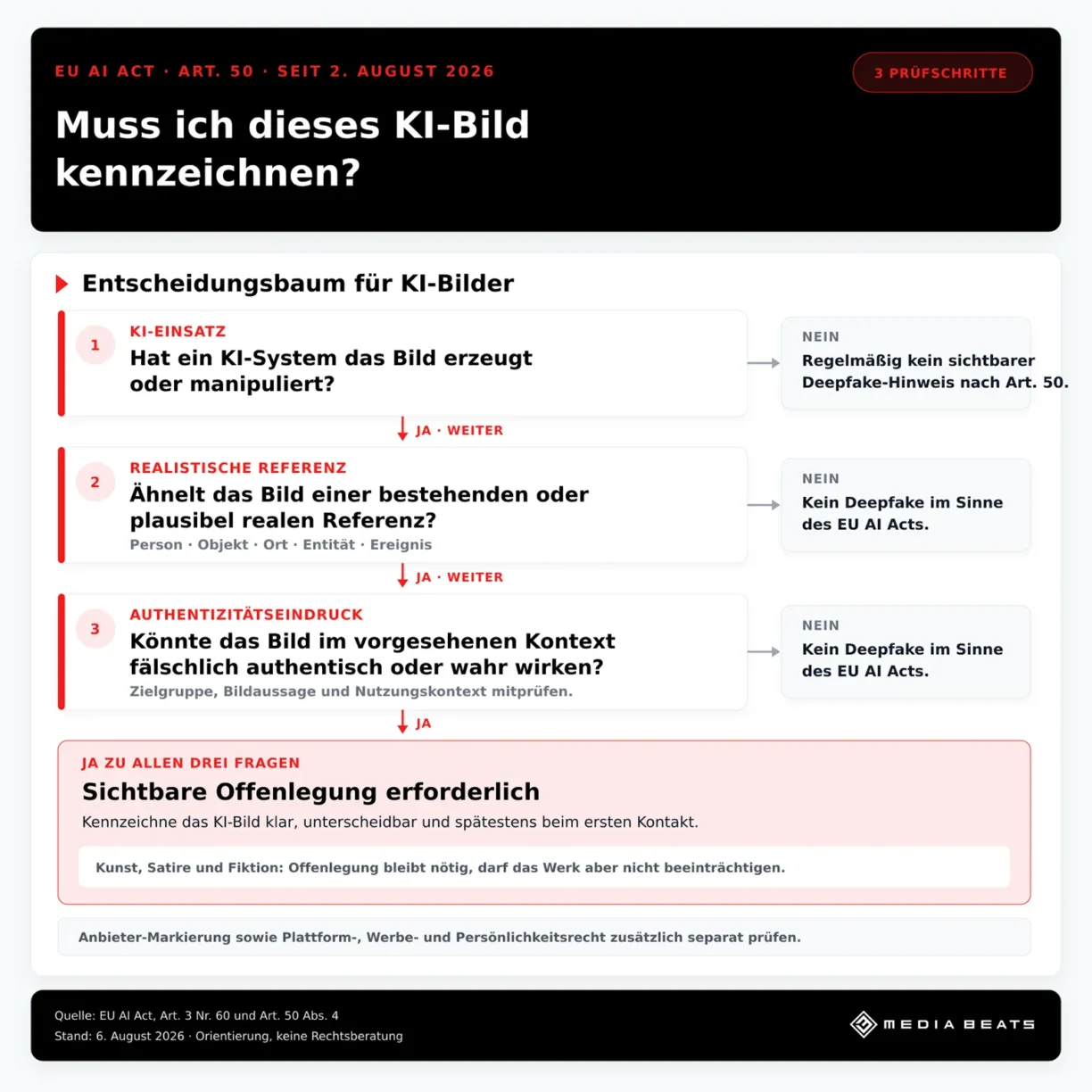
For companies, one question is especially decisive: Does the image, audio or video represent a deepfake? For this to apply, the content must replicate realistic people, objects, places, facilities or events. In addition, it must be capable of falsely appearing authentic or true.
This applies to much more than just familiar faces. Realistic AI avatars, artificially optimized products or virtually staged real estate can also be covered. By contrast, pure fantasy scenes, cartoons or insignificant technical edits often do not require a visible notice.
In this article, you will learn when you must label AI images. You will also get a decision logic, practical examples and suitable wording. The basis is Art. 50, the final guidelines of the European Commission and the information provided by the Federal Network Agency. However, this article does not replace a legal review of the individual case.
What does “labeling AI images” mean under the EU AI Act?
Labeling AI images means clearly and understandably disclosing artificial creation or editing to affected persons. Under Art. 50 paragraph 4, this obligation applies to providers of an AI system if its image, audio or video output represents a deepfake.
An operator is a company that uses an AI system professionally under its own responsibility. You decide on the purpose and type of use. Technical control over the model is not strictly required. Therefore, if your team uses an image generator for a campaign, your company is generally the operator.
By contrast, if you commission an agency, the role distribution may differ. If you make no decision about the use of AI, you may not be the operator for this production step. The agency can assume this role. Contractual responsibilities and other laws nevertheless remain important.
The rules apply to operators established in the EU. Companies from third countries with intended use of their AI outputs in the EU are also covered. Unforeseeable distribution to Europe, however, is not always sufficient. Purely private, non-professional uses by natural persons are generally exempt.
The visible operator obligation differs from the technical provider obligation. Providers of generative AI systems must generally mark synthetic outputs in a machine-readable way and make them technically detectable. Metadata, watermarks or cryptographic provenance records may be used for this purpose. However, a hidden technical marker does not replace an understandable deepfake notice for an audience.
The Federal Network Agency summarizes both roles and obligations separately. This distinction should also be reflected in the internal AI governance.
When is AI-generated content considered a deepfake?
The legal definition covers AI-generated or manipulated images, audio and videos with four common characteristics:
- An AI system generated or modified the content.
- The content resembles real people, objects, places, institutions, or events.
- The resemblance is clear enough to reproduce recognizable features.
- The content may appear to be authentic or true, even though it is not.
These criteria are connected and require an overall assessment. The decisive factors are realism, content statement, publication context, target audience and their expectations. Actual intent to deceive is not required.
The broad interpretation by the European Commission is important. According to its guidelines, “existing” also includes persons or situations that realistically exist or could plausibly exist. Therefore, a completely fictional, photorealistic AI person can also fall under the deepfake definition.
Why does your company need to label AI images?
The labeling determines more than formal compliance. It also influences whether customers trust the product images, references and campaigns. Especially photorealistic content can create expectations that a real offer later fails to meet.
The risk increases when AI makes a service appear better than it is. Possible examples include altered product characteristics, artificial before-and-after results or invented testimonials. Even content that is not subject to labeling can then violate competition law, data protection, personality rights, copyright or trademark law.
A consent from the depicted person does not fully solve this problem. Such consent can be important for personality or data protection rights. However, the deepfake classification does not depend on it. An artificially altered face or a cloned voice may therefore still need to be disclosed.
This is accompanied by a significant sanctions risk. Violations of Art. 50 can cost up to 15 million euros. For companies, up to three percent of global annual turnover from the previous year is possible. In principle, the higher threshold applies. For SMEs, including start-ups, the lower value applies in each case.
The authority takes into account, among other things, severity, duration, intent, negligence and cooperation. Protective measures that have been taken may also be relevant. A documented review process therefore strengthens not only quality, but also verifiability.
How can you label AI-generated images?
When you want to label AI images, a reliable process does not start with an icon. First, you need to classify the content and usage context. Then you determine the labeling, placement and documentation.
1. Clarify Your Role in AI Implementation
First, check who decides on the LLM used and its purpose. If a company uses the system under its own responsibility, you are generally the operator. This also applies if employees or controlled service providers operate it.
Anyone who only technically distributes content is not automatically the operator of the generating system. Nevertheless, do not remove existing labels. In addition, platform rules, advertising law or contractual obligations may require disclosure.
Before you can label AI images, you should document the responsible role in writing. This prevents gaps between commissioning, production and publication.
2. Check whether AI has generated or modified an image, audio, or video
You must label AI images if the additional deepfake criteria are met. However, Art. 50 paragraph 4 does not cover every digital edit. An AI system must have generated or manipulated the relevant content. Classic edits without AI do not fall under this specific provision.
In addition, insignificant AI corrections do not automatically turn content into a deepfake. This can include noise reduction, color correction, file compression or minor cosmetic adjustments. Their effect on authenticity and meaning remains decisive.
3. Search for a realistic reference
Ask whether the content replicates a real or plausibly real person, product, place or event. Consider recognizable faces, voices, behaviors and characteristic product characteristics.
An AI image of a flying sphinx above the Eiffel Tower is recognizably unrealistic. The situation is different with a realistic company CEO supposedly announcing business results. According to the EU guidelines, even a fictional CEO avatar can be a deepfake.
4. Evaluate the potential impression of authenticity
Now check whether your audience could understand the content as a real recording or true representation. Do not look only at the visual itself. Headline, caption, landing page, advertising promise and channel change perception.
A real product in front of an artificial background is often unproblematic. However, this only applies if its appearance, characteristics and use remain accurate. If AI beautifies the product or simulates a non-existent function, the deepfake and advertising law risk increases.
Whether you must label AI images therefore does not depend on photorealism alone. The possible message conveyed to the target audience remains just as important.
5. Classify typical marketing scenarios
The following table shows when you, as a business, should label AI-generated images. It is based on the final EU examples and their practical implications. Nevertheless, each borderline case requires an individual assessment.
| Marketing case | Classification pursuant to Article 50 | Practical Recommendation |
|---|---|---|
| A real person in a fictional, photorealistic situation | Regular Deepfake | Disclose that content is AI-generated or AI-modified |
| A realistic synthetic influencer promotes a real product | Could be a deepfake; not necessarily a creative exception | Clearly label and review advertising claims separately |
| AI changes a product's form, quality, or use | Deepfakes are possible; additional risk of deception | Disclose and compare the presentation with the actual product |
| An empty apartment is realistically furnished using AI | Official example of content partially modified by AI | Make virtual staging clearly visible |
| Real product against a purely artificial background | It's often not a deepfake if the product remains intact | Review the context and document the decision |
| Color correction, noise reduction, or minor retouching | Often Not a Deepfake When the Impact Is Insignificant | No blanket labeling, but evaluate the processing |
| Cartoon, recognizable illustration, or physically impossible fantasy scene | As a rule, there is no deepfake without the potential to deceive | Note: This is generally not required under Article 50 |
| Face swap, voice cloning, or staged scenes | Regular Deepfake | Disclose information early, clearly, and in a media-friendly manner |
| Satire, art, fiction, or memes using deepfakes | Not completely gutted | Disclose the use of AI processing appropriately |
An outfit change, background extension or inserted person is therefore not automatically subject to labeling. If the edit creates a false impression of authenticity, you should label AI images.
6. Write a clear note
When you must label AI images, Art. 50 requires clear, distinguishable and accessibly perceptible information. Use simple language and describe the scope as precisely as possible. Suitable wording includes, for example:
- "Created entirely with AI—not a real photograph"
- "Image partially altered using AI"
- "Virtual Staging: Interior Design Enhanced with AI"
- "Artificially generated voice"
- "The face and the scene were altered using AI"
Avoid vague terms such as “digitally optimized” when there is significant AI manipulation involved. Your disclosure should make the artificial origin clear.
7. Place the label upon initial contact
You must label AI images before your audience can overlook their artificial origin. The notice must be recognizable no later than the first point of contact. On a website, a clearly assigned caption can work. Even more robust is an overlay within the medium or a clearly connected interface notice.
On social media, the labeling should already appear in the post or directly within the medium. A hidden notice in the legal notice, general terms of use or behind several menus is not sufficient. For videos, the information should remain readable long enough. For audio, you need an understandable spoken or equivalent disclosure.
The EU provides three voluntary icon types: a basic icon, “fully AI-generated” and “partially AI-altered.” The icon alone does not guarantee legal compliance. The Commission recommends understandable text labels and placement that remains intact even after downloads or shares. You can find details on the official page about the EU icons for AI content.
For images, also add suitable alt text or an ARIA label. The labeling must be perceptible to users with assistive technologies. However, alt text must not remain the only visible disclosure for all other users.
8. Document your decision
Create a short review log for each relevant asset. Record the tool, creation date, scope of editing, deployment channel, target audience and decision. Also save the final file including the labeling.
A central standard prevents contradictory information between the website, social media marketing, ads and email marketing. Therefore, anchor it in your online marketing strategy and in approval processes.
What opportunities and risks does labeling present?
Good AI labeling builds trust without devaluing creative work. Customers understand what they are seeing and can better assess advertising claims. At the same time, a consistent process protects your brand from avoidable misunderstandings.
However, too many blanket statements can also be harmful. If you label every color correction as AI content, the information loses its significance. Furthermore, it creates the false impression that Article 50 prohibits or stigmatizes AI content.
The greater risk lies in defining deepfakes too narrowly. Photorealistic avatars are not automatically exempt simply because no specific person was used as a template. The final guidelines explicitly mention realistic AI personas and synthetic influencers as possible deepfakes.
Even art, satire and fiction are not complete exemptions. If such a work contains a deepfake, you must still disclose its existence. However, you may implement the labeling in a way that does not unreasonably impair the enjoyment or presentation.
Human review also does not exempt images, audio and videos from deepfake disclosure. The exception for human review concerns certain AI-generated texts on matters of public interest. In addition, a natural or legal person must assume editorial responsibility.
Does this requirement also apply to older AI-generated content?
Deepfakes that were generated or manipulated before August 2, 2026, do not have to be labeled retroactively according to the Commission guidelines. Voluntary disclosure remains recommended.
The transition period until December 2, 2026, applies exclusively to the providers’ technical marking and detection obligation. This period applies to systems that were already on the market before August 2, 2026. Your visible operator obligation for newly generated deepfakes was not postponed by this.
How will you label AI-generated images in the future?
Visible markings will become more closely integrated with technical origin signals in the future. Machine-readable markers are intended to enable platforms, search systems, and verification tools to perform more reliable detection. Open standards can link metadata, signatures, and traceable origin information.
When you have to label AI images in the future, visible and technical signals will therefore interact more closely. This increases the requirements for clean source files.
For your marketing projects, this means: A caption alone will not be a complete workflow in the long term. You need asset management, binding approvals and preserved provenance data. Especially in performance marketing and scaled content production, the risk of errors otherwise increases.
The voluntary EU practical guide provides a EU-wide recognized framework for this purpose. Companies may also choose other appropriate measures. In that case, however, they must provide a clear explanation to the authorities demonstrating that those measures are equivalent.
The Commission intends to update its guidelines based on practical experience and future case law. You should therefore review your rules regularly. The guidelines show the current Commission interpretation, but do not replace a court ruling. Current foundations are provided by the European Commission guidelines, its FAQ on Art. 50 and the wording of Art. 50.
Conclusion: When do you need to label AI-generated images?
You do not have to label every AI image. The visible obligation under Art. 50 applies to you as an operator primarily in the case of deepfakes. The use of AI, realistic similarity and a possible false impression of authenticity are considered together.
Therefore, do not only check whether AI was involved. Also assess the message, channel, target audience and expectations. A realistic avatar, an enhanced product or virtual staging can be subject to labeling. A recognizable fantasy scene or insignificant technical correction often remains outside the deepfake rule.
The practical decision rule is: Can your AI medium appear like a real recording of plausible people, products, places or events? Can it also simulate a true representation? Then you should clearly disclose the artificial creation or alteration and document your decision.
Do you want to use AI content efficiently, brand-compliantly and with reliable approval processes? Our AI agency supports you from strategy to content production. For a specific inquiry, you can directly contact Media Beats.
Legal Notice: This article provides an editorial analysis and is not legal advice. Have high-risk borderline cases reviewed by a lawyer.
FAQs about labeling AI-generated images
No. Article 50 primarily requires you, as the operator, to disclose deepfakes. The key factors are realistic resemblance and the potential to give a false impression of authenticity.
That is possible. The EU guidelines also cover realistic individuals who could plausibly exist. A recognizable cartoon with no potential to mislead, on the other hand, is generally not covered by them.
The notice must be clear, distinguishable, and accessible no later than the first point of contact. It may appear directly within the medium or as a clearly identified interface notice.
Not automatically. The icon is optional and does not, on its own, prove compliance with the law. Whenever possible, combine it with a clear description of how the AI was created or modified.
This does not apply to deepfake images, audio, and videos. The exception requiring human review applies to certain AI-generated texts on topics of public interest where editorial responsibility applies.
Sources
Verified on August 6, 2026, based on official sources:
Our blog
Latest news
With our blog, you are always close to our work, our current projects and the latest trends and developments in web and print.





Any questions?