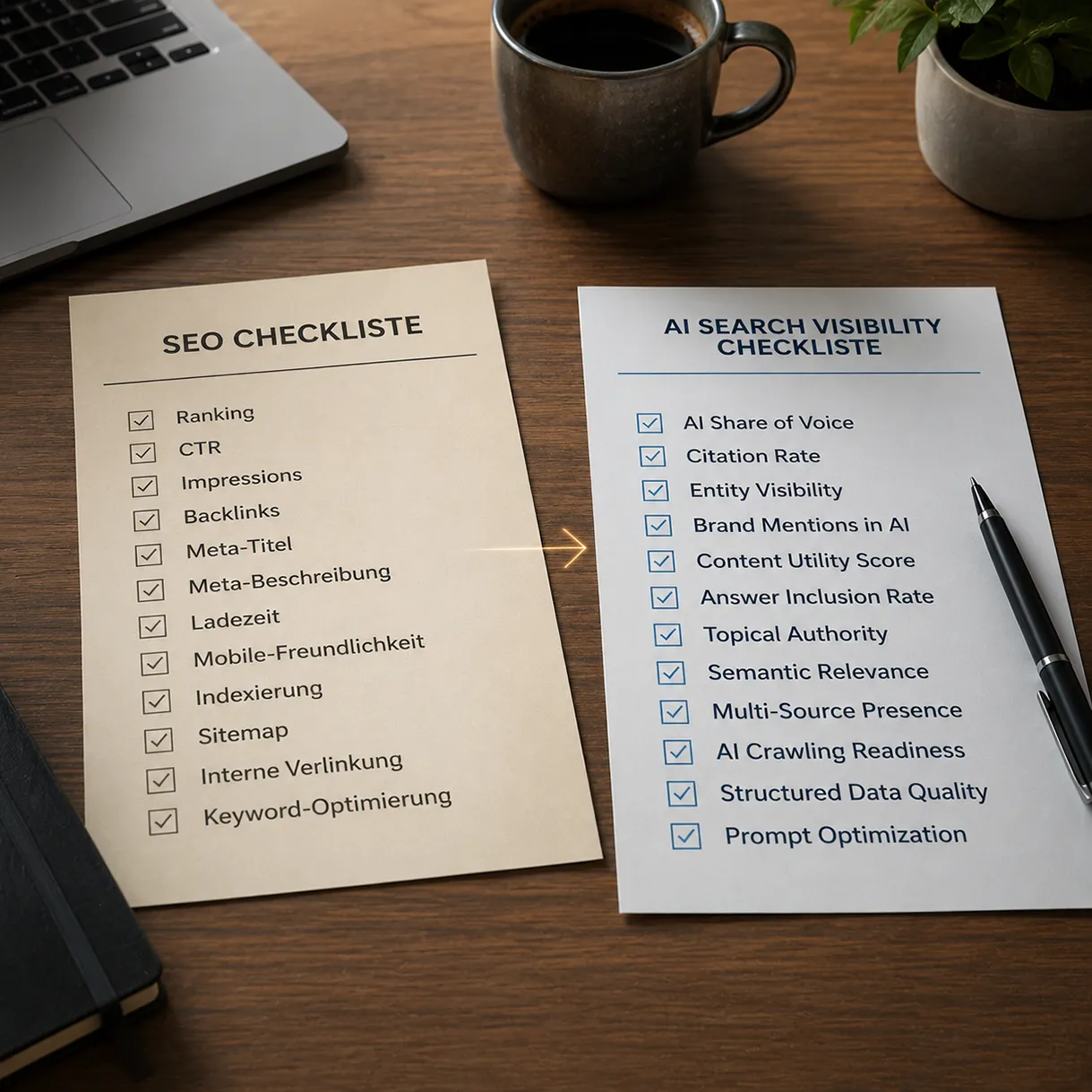
How AI is changing key SEO metrics
2. October 2026
SEO traffic is losing its significance in the age of AI. Find out which new KPIs now make visibility, trust, and demand truly measurable…
Overview
- You'll learn why, in the age of AI, SEO goes beyond traditional rankings and clicks, and why new metrics like AI Share of Voice and Citation Rate are becoming crucial.
- You'll learn how to optimize content for Google AI Overviews, ChatGPT, Perplexity, and other AI search systems to build visibility and demand.
- You'll discover which strategies and KPIs will make your brand more successful in the future and why early AI optimization can create a decisive competitive advantage.
The ongoing development of AI is fundamentally transforming the most important SEO metrics. Previously, the rule was: Strong rankings generate visibility, visibility generates clicks, and clicks generate revenue. Today, this logic is no longer reliable.
Google AI Overviews, ChatGPT, Perplexity, and other AI search systems answer many questions directly. As a result, search remains relevant, but the website click is becoming less important. Users receive answers, compare providers, and make preliminary decisions without immediately visiting your website.
For you, this means: Traditional SEO metrics such as rankings, impressions, and organic traffic remain important. However, they are no longer sufficient to realistically assess success. What matters is whether your brand appears in AI-generated answers, is cited, and subsequently generates demand.
In this article, you will learn why search engine optimization in the AI era requires new metrics. You will discover which metrics are becoming less important, which new KPIs are emerging, and how to optimize your content for search engines and AI systems.
How Is SEO Changing in the Age of AI?
SEO in the AI era refers to optimizing content for traditional search engines and AI-powered answer systems. These include Google AI Overviews, ChatGPT, Perplexity, Gemini, and other systems that summarize information and make recommendations.
Traditional SEO focuses heavily on rankings, click-through rate, organic traffic, and technical discoverability. These fundamentals remain important. However, AI systems are changing how users consume information.
Instead of comparing ten search results, many users read a direct answer. This answer often includes only a few sources or mentions providers without generating a traditional click. This creates visibility that is barely visible in many analytics tools.
SEO in the AI era therefore expands optimization to include concepts such as GEO, AEO, and LLM visibility. GEO stands for Generative Engine Optimization. AEO stands for Answer Engine Optimization. Both approaches pursue the same goal: Your content should be understandable, citable, and recommendable for AI systems.
For you, the only question is no longer: “Does my page rank on Google?” Another crucial question is: “Does AI recognize my brand as a relevant source for this topic?”
How important is SEO today?
SEO is important today because search behavior is undergoing a structural shift. Users continue to search for information, products, and solutions. However, they click on traditional search results less often when AI-generated answers already address most of their questions.
Recent studies show that AI Overviews can significantly reduce the likelihood of clicks. Users are more likely to remain on the search results page or switch directly to a branded search. As a result, organic traffic appears weaker, even though your brand may have previously been visible.
This is particularly relevant for companies that rely heavily on informational content. Blog posts, guides, glossaries, and comparison pages continue to generate reach. However, some of this reach can no longer be measured through website visits.
At the same time, a new opportunity is emerging. Appearing in AI-generated answers can help companies build trust at an early stage. AI handles part of the initial selection process. If users subsequently search directly for your brand, subscribe to your newsletter, or submit an inquiry, this interaction is often more valuable.
For online marketing, this means that SEO is becoming less of a pure traffic channel and more of a visibility, trust, and demand channel. That is precisely why you need new metrics.
Which traditional SEO metrics are becoming less meaningful?
Rankings are not losing their importance, but they are no longer the sole benchmark. A number-one ranking on Google no longer automatically guarantees many clicks. If an AI Overview appears above the organic result, attention toward traditional listings decreases.
Impressions are also becoming more difficult to interpret. A page can be visible without users clicking on it. At the same time, your brand may appear in an AI-generated answer without this visibility being accurately reflected in Search Console.
Organic traffic remains important, but it now reveals only part of the picture. Particularly for informational search queries, traffic may decline even though your content continues to influence decisions.
The traditional session-based conversion rate can also be misleading. When LLMs prequalify users, fewer visitors reach your website. However, these visitors may be more ready to buy. A lower traffic volume does not therefore automatically indicate poorer performance.
You should continue to monitor these metrics:
- Rankings for important keywords
- Organic clicks
- Impressions in Google Search Console
- CTR by keyword group
- Organic revenue
- Branded traffic
- Direct accesses
- Assisted conversions
The difference lies in how these metrics are interpreted. You should no longer view these values in isolation, but connect them with AI visibility, branded searches, and revenue quality.
Which new SEO metrics matter now?
In the AI era, you need metrics that measure visibility within AI-generated answers. One of the most important is AI Share of Voice. This metric shows how often your brand is mentioned in response to typical AI prompts compared with competitors.
A second important metric is the Citation Rate. It measures how often your content appears as a source in AI-generated answers. This is particularly relevant for Google AI Overviews, Perplexity, and other systems that display sources visibly.
The Inclusion Rate is also becoming more important. It indicates whether your brand appears in an AI-generated answer, even when no direct link is provided. Such a mention can be particularly valuable for consulting, software, e-commerce, and B2B topics.
Other relevant metrics include:
- Entity Visibility: How clearly does AI recognize your brand as a relevant entity
- Prompt Coverage: For how many important prompts does your brand appear?
- Branded Search Lift: Do branded searches increase following AI visibility?
- AI Referral Traffic: How many visits come from ChatGPT, Perplexity, or Gemini?
- Revenue per AI Visit: How valuable is AI-referred traffic?
- AI-Assisted Revenue: What revenue is generated indirectly by AI recommendations?
These KPIs provide a clearer picture of how visible your brand is across emerging search systems. They also help you connect SEO more closely with performance marketing and branding.
How SEO works in practice in the age of AI
SEO today begins with a clear content structure. AI systems favor content that answers questions precisely, is well structured, and provides trustworthy information.
You should therefore structure your content more around answer blocks. Each important section should answer a specific question. Short definitions, clear lists, comparison tables, and easy-to-understand examples are ideal.
A good structure looks like this:
- A brief definition at the beginning
- Clear H2 and H3 questions
- Concise answer in the first paragraph
- Further exploration with examples
- Structured data
- Internal links to relevant service pages
- External sources of reliable studies
It is also important for AI systems to understand your brand clearly. This requires consistent information about your company, your services, your target audiences, and your expertise.
A strong website alone is not always enough. LLMs also consider external signals. These include mentions on industry publications, business directories, review platforms, YouTube, social media, and relevant third-party websites.
Building topical clusters is particularly important. For example, if you want to be found for online marketing, you should not rely solely on a general service page. You need supporting content covering:
Each of these pieces of content should be internally linked. This creates clear topical authority. At the same time, AI systems can better understand what your brand represents.
What tools are useful for SEO today?
You can analyze many fundamentals with established SEO tools. Google Search Console, GA4, SISTRIX, Semrush, Ahrefs, and Screaming Frog remain important. They show you rankings, technical issues, impressions, clicks, and content structures.
Additionally, you need new evaluation processes. Regularly test relevant prompts in ChatGPT, Perplexity, Gemini, and Google AI Overviews. Check whether your brand appears, which competitors are mentioned, and which sources the systems prefer.
Examples of prompts:
“Which online marketing agencies in Munich are recommended?”
“Which agency can help with email marketing and performance marketing?”
“What should I consider when approaching SEO in the AI era?”
“Which providers are suitable for B2B online marketing?”
“Which agency offers web development and SEO services?”
Document the results in a table. Record the date, tool, prompt, mentioned brands, sources, and position within the answer. This creates a simple AI visibility monitoring system.
For analytics, you should track referrers from AI platforms separately. These include chatgpt.com, perplexity.ai, gemini.google.com, and other relevant domains. This allows you to analyze AI traffic as a separate channel.
Opportunities and Risks of SEO in the Age of AI
The greatest opportunity lies in high-quality visibility. When an AI system recommends your brand, many users perceive it as an impartial initial selection. This recommendation can build trust before the first website visit occurs.
In addition, AI traffic can be more valuable than traditional top-of-funnel traffic. Users often arrive at your website better informed. They have already answered important questions and compare providers more specifically. As a result, leads and inquiries may be of higher quality.
The greatest risk lies in traffic loss. Guides, glossaries, and simple informational pages in particular lose clicks when AI systems summarize answers directly. Those who optimize solely for traffic volume will quickly see weaker figures as a result.
Another risk is the lack of measurability. Many AI-driven interactions later appear as direct traffic, branded search, or organic branded traffic. Without adapted reporting, you underestimate the contribution of your content.
Dependence on platforms is also increasing. Google, OpenAI, and other providers decide which sources become visible. Therefore, you should not only strengthen your brand on your own website, but also make it visible across multiple channels.
The Future of SEO in the Age of AI
The future of SEO will become more hybrid. Traditional search engines will not disappear. However, they will increasingly merge with AI-generated answers, shopping modules, local results, videos, and direct recommendations.
For you, this means that SEO will become more closely connected with content marketing, PR, social media, email marketing, and performance marketing. Individual rankings are no longer sufficient. What matters is whether your brand is visible wherever decisions are being shaped.
Entity optimization is becoming particularly important: Your brand must be clearly identifiable by search engines and AI systems. This requires consistent company information, clear service pages, structured data, and external validation.
E-E-A-T also continues to gain importance. Experience, expertise, authority, and trust do not only help with Google. They also help AI systems assess your content as a reliable source.
Those who invest in AI visibility early gain a competitive advantage. Many companies still measure only traditional SEO metrics. This creates opportunities for brands that understand more quickly how new search systems work.
Conclusion
SEO in the AI era does not mean that traditional SEO metrics are disappearing. Rankings, clicks, and organic traffic remain important. However, they no longer provide the complete picture.
The click is no longer the only evidence of visibility. Your brand can appear in AI-generated answers, influence users, and generate future demand without immediately producing a measurable website visit.
That's why you need a new Reporting. Take a look:
- AI share of voice
- Citation rate
- Inclusion rate
- Branded search lift
- AI referrals
- Revenue quality
Combine these metrics with traditional SEO data rather than looking at them separately.
When you optimize your content for search engines and AI systems, you strengthen your digital presence sustainably. Media Beats helps you strategically align SEO, online marketing, performance marketing, and content with the AI era.
Frequently Asked Questions About SEO in the Age of AI
What Does SEO Mean in the Age of AI?
SEO in the AI era means optimizing content for traditional search engines and AI answer systems. The goal is not only to achieve a strong ranking, but also visibility in AI Overviews, ChatGPT, Perplexity, and similar systems.
Are keywords still important?
Yes, keywords remain important. They help search engines and AI systems categorize topics. However, pure keyword optimization is no longer sufficient. Content must answer questions precisely and demonstrate genuine authority.
Why is organic traffic declining despite good rankings?
Organic traffic may decline because AI-generated answers answer many questions directly. Users then click on traditional search results less often, even though your content remains visible or indirectly relevant.
What new KPIs should I track?
You should measure AI Share of Voice, Citation Rate, Inclusion Rate, Branded Search Lift, AI referral traffic, and Revenue per Visit. These metrics show how visible and valuable your brand is across AI search systems.
How do I optimize content for AI systems?
Create clear answer blocks, use structured data, build topical clusters, and strengthen your brand beyond your own website. The more clearly your expertise becomes visible, the better AI systems can categorize your content.
Frequently Asked Questions About SEO in the Age of AI
SEO in the AI era means optimizing content for traditional search engines and AI answer systems. The goal is not only to achieve a strong ranking, but also visibility in AI Overviews, ChatGPT, Perplexity, and similar systems.
Yes, keywords remain important. They help search engines and AI systems categorize topics. However, pure keyword optimization is no longer sufficient. Content must answer questions precisely and demonstrate genuine authority.
Organic traffic may decline because AI-generated answers answer many questions directly. Users then click on traditional search results less often, even though your content remains visible or indirectly relevant.
You should measure AI Share of Voice, Citation Rate, Inclusion Rate, Branded Search Lift, AI referral traffic, and Revenue per Visit. These metrics show how visible and valuable your brand is across AI search systems.
Create clear answer blocks, use structured data, build topical clusters, and strengthen your brand beyond your own website. The more clearly your expertise becomes visible, the better AI systems can categorize your content.
Our blog
Latest news
With our blog, you are always close to our work, our current projects and the latest trends and developments in web and print.





Any questions?