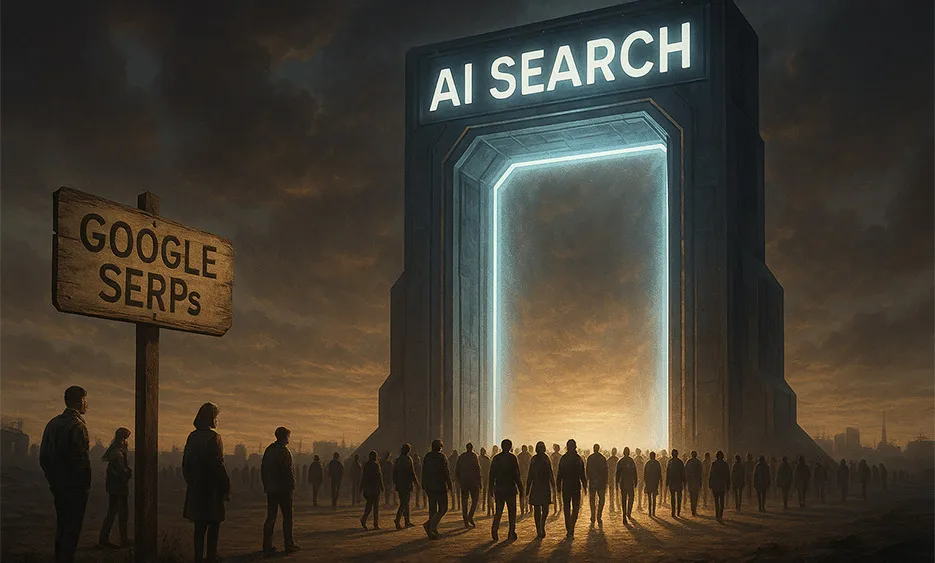
SEO & AI in transition: strategies, trends, and best practices for professionals
3. October 2025
The SEO industry is changing faster than ever before. With the rise of Google Gemini, ChatGPT, and Perplexity, traditional search engine optimization is no longer enough.
Search behavior is shifting from keywords to conversational, AI-generated answers. New disciplines like AIO (AI Optimization), GEO (Generative Engine Optimization), AEO (Answer Engine Optimization), and SXO (Search Experience Optimization) are expanding SEO into an integrated ecosystem.
This guide provides in-depth insights into the fundamentals, best practices, challenges, and trends that will be relevant from 2025 onwards.
What is modern SEO?
SEO now means much more than just rankings in the Google SERPs. While it originally focused on technical factors like PageRank or updates like BERT, search engine optimization today takes into account the impact of generative AI. SEO remains the foundation, but it must be expanded.
Core tasks in modern SEO
Keyword research with a semantic focus and long tails
Traditional keyword research has changed significantly. Instead of focusing solely on search volume and main keywords, semantic analysis is now taking center stage. Search queries today are more complex, often phrased as questions, and influenced by voice search. Long-tail keywords like "How do I optimize content for ChatGPT?" reflect this shift. They not only better represent user behavior but also increase the likelihood of appearing in AI-generated answers. For SEO experts, this means using tools like Ahrefs or SEMrush more strategically for semantic clusters and topic fields.
On-page optimization with schema markup, structured data, and E-E-A-T
On-page SEO involves more than just title tags and meta descriptions. In the age of AI, content structuring plays a key role. With schema markup, content can be clearly labeled for search engines and AI systems — for example, through FAQ or How-To schemas. At the same time, E-E-A-T (Experience, Expertise, Authoritativeness, Trustworthiness) is more important than ever, as AI engines heavily rely on trust signals. Author information, source references, and a clear site architecture help make content visible not only in traditional SERPs but also in AI overviews.
Off-page optimization with high-quality backlinks and reputation building
Backlinks remain a key element of any SEO strategy, but the requirements have evolved. Quality is more important than quantity. Links from thematically relevant, trustworthy sources not only improve your Google ranking but also increase the likelihood of being cited by AI systems as a reference source. In addition to traditional link building strategies, building digital reputation is gaining importance — for example, through mentions on Wikidata, industry portals, or niche directories. This trust-building has a lasting effect and helps protect against the negative impacts of spam updates.
Technical SEO with Core Web Vitals, mobile-first indexing, and crawlability
Technical SEO forms the foundation of a successful online presence. Google and AI systems increasingly evaluate websites based on their technical performance. Core Web Vitals — such as loading speed, interactivity, and layout stability — are crucial for rankings and overall user experience. Mobile-first indexing ensures that content is displayed optimally across all devices. A new challenge has also emerged: crawlability for AI scrapers. Businesses should strategically manage their robots.txt files to make relevant content accessible to AI while protecting sensitive data.
Measurement via GA4, Search Console, and citation frequency
Measuring SEO success requires updated metrics. In addition to classic indicators like organic traffic, bounce rate, or SERP positions, AI-specific data is becoming increasingly relevant. One key metric is citation frequency — how often your content is cited in AI-generated answers. Tools like Google Analytics 4 and Google Search Console still provide valuable insights, but they must be complemented by AI-specific tracking. Monitoring these new KPIs closely helps you detect early how your content performs in generative search environments — and lets you adapt your strategies accordingly.
SEO is the foundation on which advanced disciplines like AIO, GEO, AEO, and SXO are built.
Why is SEO important in the age of AI?
Only 20 to 30 percent of search queries will end in a click on a website in 2025. Zero-click searches and AI-generated answers are dominating. Companies risk losing visibility if they don’t consistently adapt their search engine optimization.
Overview of the relevance of SEO:
- Protection against loss of visibility due to zero-click features
- Securing traffic through integration into AI-generated answers.
- Competitive advantage through combined strategies of SEO, AIO, and SXO.
- Foundation for conversions in complex customer journeys.
SEO is no longer isolated, but part of a comprehensive search and experience management.
How modern SEO works in practice
Schritt-für-Schritt-Strategien
1. Keyword analysis with a semantic focus and inclusion of voice search.
2. Create structured content that works as standalone answers.
3. Technical optimization for loading times, mobile-first, and AI crawlability.
4. Strengthen off-page signals through high-quality collaborations and expert contributions.
5. Update content regularly to counteract AI hallucinations.
6. Integrate UX and conversion optimization so that visibility leads to leads.
Tools, methods, and examples
- Ahrefs and SEMrush for semantic keyword research.
- Perplexity AI and Surfer SEO for AIO testing.
- Yoast or RankMath for AEO.
- Hotjar and Optimizely for SXO analyses.
- GA4 and Search Console for measurement.
| Disziplin | Fokus | Tools | KPIs |
|---|---|---|---|
| SEO | Rankings, technical basis | Ahrefs, GA4 | Traffic, Position |
| AIO | Optimization for AI systems | Perplexity, Surfer SEO | Citations in AI |
| GEO | Generative Engine Optimization | SEMrush GEO | AI-Response-Position |
| AEO | Zero-click and snippets | Yoast, RankMath | Snippet-Impressions |
| SXO | User Experience & Conversion | Hotjar, Optimizely | Conversion Rate |
Opportunities and risks of SEO in transition
SEO opens up new opportunities to strategically strengthen your online presence and achieve greater reach. At the same time, it also carries risks if strategies are poorly implemented or key factors are overlooked.
Opportunities:
- Visibility in AI overviews.
- Personalized user experiences through SXO.
- Cross-channel strategies combining social and search.
Risks:
- Dependence on AI–algorithms.
- Content theft through zero-click features.
- Fast-paced updates require constant adaptation.
Short FAQs
What is the greatest risk?
The biggest risk lies in the loss of visibility due to zero-click searches and AI takeovers.
Welche Chance ist am wichtigsten?
Integration into AI-generated responses offers long-term reach and trust.
Wie lässt sich das Risiko reduzieren?
Through channel diversification, continuous audits, and clear content strategies.
The future of SEO
SEO is evolving into an AI-centered ecosystem by 2030. New trends are emerging:
- Voice search optimization continues to rise
- AI ads in overviews are becoming a reality.
- Agentic AI systems automatically integrate SEO into customer journeys.
- Hybrid teams of SEO experts and data scientists are setting new standards.
Search engine optimization will not disappear, but rather merge: Search Everywhere Optimization combines classic methods with artificial intelligence, social, and experience strategies.
Conclusion
SEO is undergoing a fundamental transformation. From rankings to AI integrations, it now encompasses AIO, GEO, AEO, and SXO. Companies that combine strategies, understand user intent, and use AI-powered tools are the ones that succeed. The next step: act instead of wait. Gain a competitive edge by rethinking SEO in the AI era.
Contact us for a personalized consultation and discover how we can future-proof your online marketing.
FAQs about modern SEO
Our blog
Latest news
With our blog, you are always close to our work, our current projects and the latest trends and developments in web and print.






Any questions?